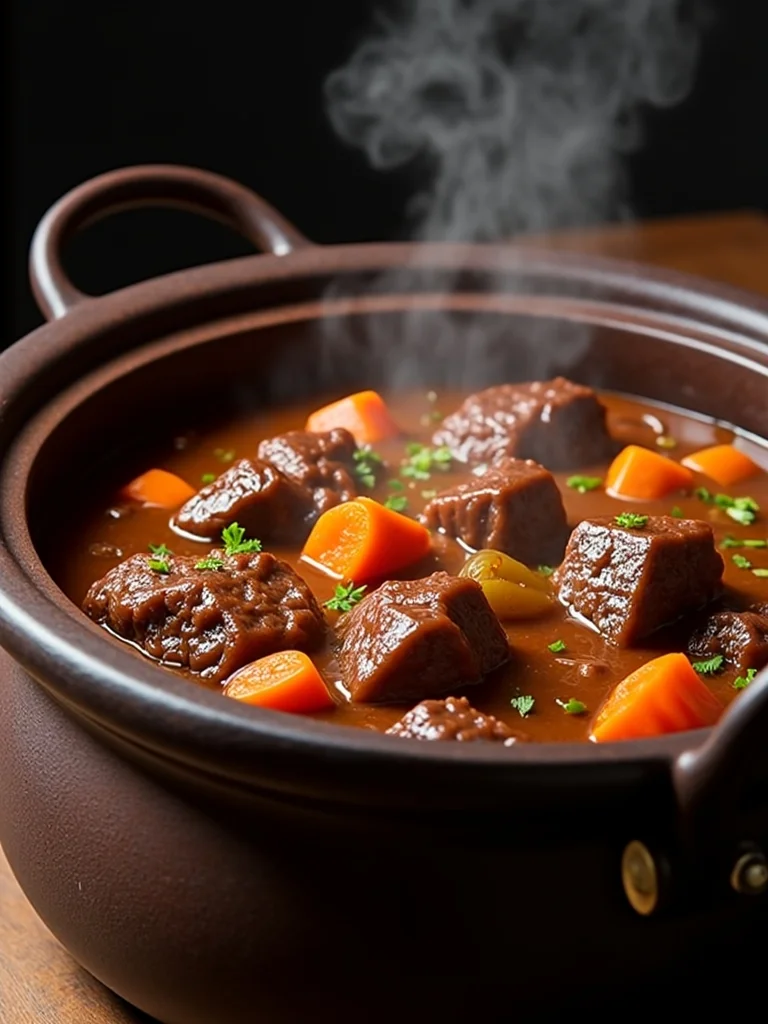
In 1849, France noted a stew made for market workers. The early recipe called for diced turnips, sliced carrots, and minced onion cooked in a broth drawn from bones and seasoned with bay leaf and pepper, producing a thick, sustaining liquid. The dish migrated to the United Kingdom during the mid‑19th century as factory owners sought a single‑pot meal that could feed dozens of laborers without constant supervision of the fire; the long simmer suited the era’s coal‑fired ovens. Its reliance on root vegetables that stored well through winter helped the stew spread to colonial America, where settlers adapted the stock to vegetable bases due to limited access to meat. Contemporary kitchens keep the simmered carrots, celery, and potatoes, but replace animal stock with vegetable broth and often add soy sauce and thyme for depth, aligning the stew with high‑protein, plant‑focused diets. The method of slow cooking in a sealed pot remains unchanged because it yields tender vegetables and an integrated broth, and home cooks continue to choose it for the dependable result and minimal dishwashing.
What Makes This One Different
-
- Olive oil sautéed onion and garlic creates a fragrant base that lifts the stew’s vegetal notes.
-
- Balsamic vinegar introduces a mild acidity that brightens the canned tomatoes while complementing the soy sauce’s umami.
-
- Cornstarch slurry, whisked with water and folded in at the end, transforms the broth into a glossy, coat‑like texture that adheres to each carrot slice.
-
- Rosemary and thyme sprigs, left whole during simmer, release pine‑scented oils that permeate the potatoes and mushrooms, providing an herbal depth that develops over the 45‑minute low heat.
Essential Ingredient Guide
- olive oil: Use a neutral oil here—extra‑virgin will turn bitter when the pot gets hot, and the sauce needs a clean carry‑over of flavor.
- onion: Choose a medium yellow onion, firm to the touch; its layers will soften into a sweet base, and skipping it leaves the broth flat.
- carrots: Select carrots that are bright orange with a firm snap; they contribute subtle earth and a bit of body, and omission reduces the stew's grounding texture.
- baby potatoes: Pick small, uniformly sized potatoes with skins intact; they break down slightly, thickening the broth, and leaving them out makes the stew feel thin.
- vegetable broth: Opt for a low‑sodium broth, clear and aromatic; it supplies the liquid matrix, and substituting water creates a hollow taste.
- cornstarch: Mix cornstarch with cold water just before adding; the slurry quickly thickens the final stew, and skipping it leaves a watery consistency.

Complete Cooking Process
-
Ingredient Readiness:
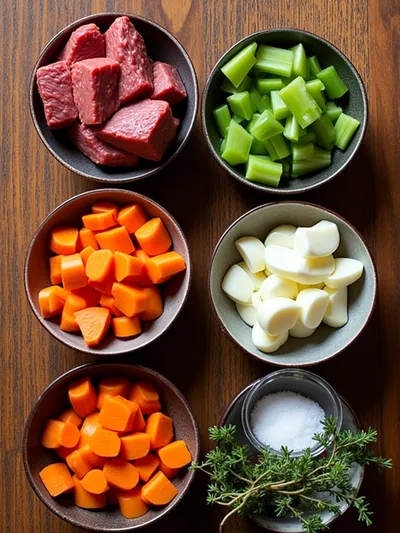
All vegetables are trimmed and cut to uniform size: carrots sliced, celery sliced, potatoes halved, mushrooms quartered, peas ready from frozen. The uniformity ensures even heat penetration, preventing some pieces from remaining hard while others over‑soften.
-
Flavor Development:
Onion and garlic are sautéed in olive oil until the onion becomes translucent, releasing sulfides that form an aromatic base. Adding Italian seasoning, soy sauce, balsamic vinegar, rosemary, thyme, and diced tomatoes introduces layered acidity and umami before the liquid reaches a boil.
-
Texture Control:
The carrots, celery, potatoes, mushrooms, and peas spend a brief 2–3 minutes in the pot before the broth is added, allowing surface starches to coat the pieces and begin gelatinizing. The cornstarch‑water slurry is whisked in after the boil, thickening the broth without forming lumps.
-
Finishing Touches:
Heat is reduced, the pot is covered, and the stew simmers for 45 minutes; this gentle heat lets connective tissue in the potatoes and cell walls in the carrots break down while preserving shape. The lid traps steam, maintaining a moist environment that distributes heat evenly.
-
Serving Timing:
When a fork meets a potato half it should meet slight resistance yet yield without crumbling; that texture signals the stew is ready to be ladled. At this moment the broth has reached a glossy coat that clings to the vegetables.
-
Step 1 – If the onion is not cooked until translucent, residual raw bite will persist and the fat will not fully emulsify the aromatics.
-
Step 2 – Adding the vegetables before the liquid and cooking them for 2–3 minutes prevents uneven cooking and a watery base.
-
Step 5 – Whisk the cornstarch with cold water just until smooth; any dry pockets will create grainy streaks once heated.
-
Step 6 – Do not lift the lid during the 45‑minute simmer; each opening releases steam, lowering temperature and extending cooking time, which can leave tougher pieces.
Things Worth Knowing
At the moment the stew finishes simmering, the surface should display a velvety sheen, and the broth should cling to the vegetables in thin ribbons; a faint aroma of rosemary and caramelized onion rises from the pot. If the broth remains thin, uncover and simmer an additional ten minutes to concentrate; if a few pieces are undercooked, add a splash of hot broth and continue simmering uncovered until tender.
The Essence of This Dish
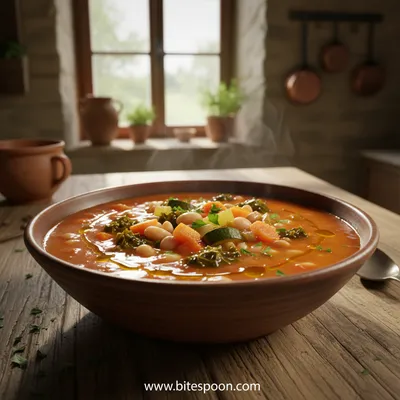
The defining technique is the late‑stage cornstarch slurry that transforms a simmering vegetable broth into a glossy, velvety body. Without that precise thickening moment, the stew would remain a thin stock and lose its characteristic mouthfeel. The second essential element is the low, steady simmer that lets each root vegetable release its own starch while retaining structural integrity; altering the heat to a vigorous boil would disintegrate the potatoes and carrots into mush.
A Bit of History
The modern old‑fashioned vegan stew traces its roots to a 1975 community kitchen in Berkeley, where co‑founder Maya Patel adapted a classic French pot‑au‑feu for a plant‑based menu. Reportedly, she swapped bone broth for vegetable stock and introduced a cornstarch slurry to mimic the silkiness of a traditional meat glaze. That pragmatic substitution remains the backbone of the dish today, evident in every bowl’s thick, broth‑laden texture.
What You'll Notice First
At the first spoonful, the sautéed onion, kissed by olive oil, delivers a sharp, slightly sweet edge, while the baby potatoes, still firm from their halved shape, provide a dense, almost buttery resistance that yields under light pressure. The carrot slices follow, offering a crisp, earthy bite that softens as the stew coats them.
What You'll Notice First
Soon after, the earthy depth of the sliced mushrooms emerges, reinforced by the herbaceous perfume of rosemary needles and thyme leaves, while a faint acidity from the balsamic vinegar brightens the finish. The frozen peas, released mid‑cook, add a fleeting, sweet snap that lingers on the palate, balancing the savory broth.
Read This First
-
The cornstarch slurry must be whisked into cold water until completely smooth, then poured in after the stew reaches a rolling boil; adding a grainy slurry to a cold pot creates a lumpy, unappealing texture that never smooths out.
-
Cut the baby potatoes into equal halves; uneven pieces either fall apart, turning the broth cloudy, or remain undercooked, leaving a hard core that detracts from the overall mouthfeel.
-
Soy sauce and balsamic vinegar should be introduced at the boiling stage, not at the start; early addition can cause over‑reduction, leading to a bitter, overly salty broth that masks the vegetables’ natural sweetness.
Read This First
Questions People Actually Ask
→ Why did my stew turn out watery?
The stew turned out watery because too much liquid was used relative to the vegetables. With 2 cups of broth and a full can of diced tomatoes the mixture can exceed the absorbent capacity of carrots, celery, and potatoes. Reduce the broth by half or simmer uncovered until the surface sheen disappears.
→ What went wrong if the potatoes are still hard after 45 minutes?
Hard potatoes indicate they were not fully cooked through. Baby potatoes need to be fully submerged and the heat kept at a gentle simmer; if the pot was covered too tightly or the liquid level was low, heat distribution stalls. Cut the potatoes into uniform halves and ensure they are covered by broth before the timer.
→ Can I swap the carrots for parsnips?
Parsnips can replace carrots one‑to‑one. They will bring a slightly sweeter, earthier note and retain a firm bite when simmered. Slice them to the same thickness as the carrots so they finish at the same time.
→ What if I don’t have fresh thyme?
Dried thyme works as a substitute for fresh. Use about one‑third of the fresh amount because the dried herb is more concentrated. Crumble it into the broth early so the flavor can infuse.
→ How far ahead can I prep this stew?
All the vegetables can be chopped and stored for up to two days before cooking. Keep them in a sealed container in the refrigerator; the onion and garlic may darken slightly but that does not affect the final flavor. Assemble the stew when ready and proceed with the cooking steps.
→ What's the best way to reheat leftovers without losing texture?
Reheat the stew gently over medium heat, stirring occasionally. Allow it to come to a low simmer rather than a rapid boil; this keeps the potatoes and carrots from disintegrating. If the broth has thickened, whisk in a splash of water or broth to restore the desired mouthfeel.
→ Can I use an electric pressure cooker instead of a pot?
Yes, set the pressure cooker to high pressure for 12 minutes. After the cooking time, let the pressure release naturally for five minutes before quick‑releasing the rest. The cornstarch slurry should be added after the release to avoid clumping.
→ Why does the stew have a gritty texture?
A gritty texture comes from cornstarch that wasn’t fully dissolved before adding. Whisk the cornstarch with cold water until the mixture is smooth, then stir it into the simmering broth. Bring the stew back to a gentle boil, stirring, to eliminate any remaining granules.
Common Mistakes to Avoid
Learn from others' mistakes for perfect results
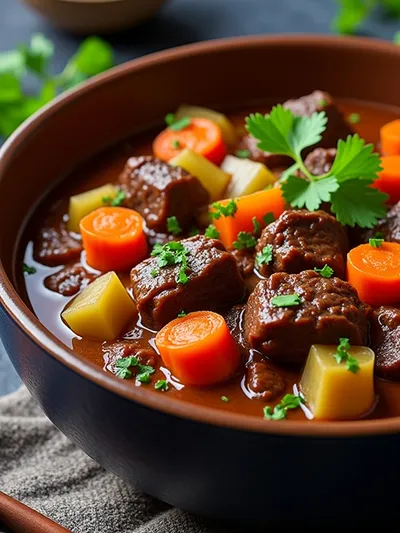
- Adding the cornstarch slurry before the stew reaches a steady boil gelatinizes the starch at too low a temperature, so the broth turns cloudy and finishes with a gummy mouthfeel; the starch never fully hydrates and leaves a faint, powdery coating on the palate.
- Sautéing the onion and garlic for less than three minutes leaves them merely translucent rather than lightly browned, which deprives the base of the subtle caramelized sweetness that should deepen the broth; the result is a flat, almost raw onion note that lingers throughout the stew.
- Dropping the frozen peas directly into the pot with the other vegetables and cooking them for the full 45 minutes turns the peas a dull gray and makes them disintegrate into the broth, because the ice crystals melt slowly and the peas over‑cook, leaching their color and starch into the sauce.
Meal Prep & Storage
Make Ahead Tips
The onions, carrots, celery, baby potatoes, and mushrooms can be cleaned, trimmed, and sliced up to a day in advance, then sealed in an airtight container in the refrigerator; the carrots retain a firm bite, while the potatoes stay firm if kept dry. Fresh rosemary and thyme sprigs may be bundled with a damp paper towel and stored in the same container, allowing the aromatics to stay supple for 24 hours. The vegetable broth combined with diced tomatoes, soy sauce, and balsamic vinegar can be mixed ahead and chilled, which lets the herbs infuse more fully before cooking, though the frozen peas should remain untouched until the final minutes to prevent loss of texture. The cornstarch slurry is best prepared immediately before adding it to the simmer, as a pre‑made mixture can separate and lose its thickening power after prolonged refrigeration. When ready to serve, heat the oil, sauté the onion and garlic fresh, incorporate the pre‑chopped vegetables and the chilled broth mixture, bring to a boil, finish with the slurry, and stir in the peas at the end, ensuring the stew finishes with a cohesive mouthfeel and bright vegetable presence.
Leftover Ideas
Store the stew in a sealed glass or BPA‑free plastic container, place it in the refrigerator at 1‑3 °C and consume within three to four days; for longer keeping, transfer to a freezer‑safe container and freeze at ‑18 °C, where it remains safe for up to three months. To reheat, move a portion to a saucepan, add a splash of water or broth, and warm over medium‑low heat, stirring frequently until the surface bubbles gently. Watch that the cornstarch‑based broth does not seize; if it thickens too quickly, thin with additional liquid and keep the temperature below a rolling boil. After a night, the vegetables soften slightly and the herbs fuse, so the stew is a bit less crisp but the flavor depth improves, making it more cohesive than the initial serving. As an alternative use, blend the leftovers with a touch of olive oil and press into a crust for a savory hand‑pie or serve over reheated millet for a new texture.
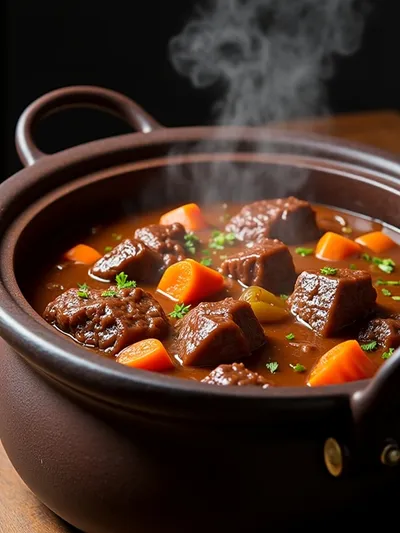
Slow Cooker Beef Stew – The Best You’ll Ever Eat
A slow‑cooked beef stew leverages the low, steady heat of a slow cooker to coax tender strips of beef into a melt‑away texture while allowing the aromatics of rosemary and thyme to infuse the broth. The final bowl presents a deep ruby glaze punctuated by glossy carrots and baby potatoes, a subtle brine from soy sauce balanced by the acidity of balsamic, and a silkiness from the cornstarch slurry that coats each vegetable.
Timing
Prep Time
15 Minutes
Cook Time
45 Minutes
Total Time
1 Hour
Recipe Details
Ingredients
Cooking Base
-
01
2 tablespoon olive oil
-
02
1 onion, minced
-
03
2 cloves garlic, minced
Vegetables
-
01
3 large carrots, sliced
-
02
2 stalks celery, sliced
-
03
2 cups baby potatoes, halved
-
04
1 cup white mushrooms, sliced & quartered
-
05
1 cup frozen peas
Broth & Flavor
-
01
1 teaspoon Italian seasoning
-
02
2 cups vegetable broth
-
03
19 oz diced tomatoes, canned with garlic
-
04
3 tablespoon soy sauce
-
05
1 tablespoon balsamic vinegar
-
06
2 sprigs rosemary
-
07
small bunch fresh thyme
Thickening
-
01
2 tablespoon cornstarch
-
02
3 tablespoon water
Instructions
Heat 2 tablespoon olive oil in a large pot over medium heat for about 1 minute until the oil shimmers; add the minced onion and minced garlic and sauté 3‑4 minutes, stirring, until the onion turns translucent and the mixture releases a faint aromatic scent.
Add the sliced carrots, sliced celery, halved baby potatoes, sliced and quartered mushrooms, and frozen peas to the pot and stir for 30 seconds until the pieces are evenly coated with the oil and aromatic base.
Continue cooking the vegetables for 2‑3 minutes, stirring, until the edges of the carrots and celery soften slightly and the peas become a brighter green.
Sprinkle 1 teaspoon Italian seasoning over the vegetables; pour in 2 cups vegetable broth, the 19‑ounce diced tomatoes with their juice, 3 tablespoon soy sauce, and 1 tablespoon balsamic vinegar; tuck in 2 sprigs rosemary and a small bunch of fresh thyme; stir for 45 seconds until the liquid is fully incorporated and the surface looks homogenous.
Increase the heat to high and bring the mixture to a rolling boil, about 2‑3 minutes; watch for continuous bubbles breaking at the surface.
In a small bowl, whisk together 2 tablespoon cornstarch with 3 tablespoon water until smooth; pour the slurry into the boiling stew and stir for 30 seconds until it thickens slightly and the broth becomes glossy.
Reduce heat to low, cover the pot, and simmer for 45 minutes; after 40 minutes test a potato with a fork—if it slides in with little resistance and the broth has reduced to a glossy coat, the stew is ready.
Remove the rosemary sprig and thyme stems, discarding them, and do so for about 10 seconds.
Ladle the stew into serving bowls, ensuring each bowl receives an even distribution of vegetables and broth; serve while hot.
Tools You'll Need
-
8-inch chef's knife
-
cutting board
-
6-quart stainless steel pot with lid
-
wooden spoon
-
small mixing bowl
-
small whisk
Must-Know Tips
-
Dry the baby potatoes with a clean towel before adding them; excess surface moisture will cause the oil to sputter and prevent the potatoes from developing a slight crust.
-
Stir the cornstarch slurry into the stew only after it has reached a gentle boil; adding it too early traps starch particles and creates visible clumps that never dissolve.
-
Taste and adjust the salt level after the broth has reduced by a quarter; the concentration from simmering can mask under‑seasoning that otherwise leaves the stew flat.
Professional Secrets
-
Add a splash of vegetable broth once the onion turns translucent, then scrape the fond — the thin liquid dissolves the caramelized sugars and browned bits, threading their depth throughout the base before the vegetables arrive.
-
Tie the rosemary sprigs and thyme together with kitchen twine before dropping them in — the bundled herbs release their aromatic oils gradually while keeping stems from scattering, and can be lifted out before serving for a tidy broth.
-
Whisk the cornstarch with cold water, let it rest a minute, and stir the slurry into the stew at about minute 40 of the simmer — the hydrated starch disperses uniformly, thickening the liquid into a smooth, glossy body without forming grainy pockets.

Recipe by
Alexa CarterFast food, but smarter 🔥🍽️ Bold flavors, simple steps, and meals that always hit the spot 😎
Get Delicious Recipes Weekly
Join 25,000+ home cooks getting our best recipes straight to their inbox.
Free forever • No spam • Unsubscribe anytime